Subscribe
SUBSCRIBE!
Ye Dog C*nts
Creative Commons License

This work is licensed under a Creative Commons Attribution-NonCommercial-NoDerivatives 4.0 International License.
Showing posts with label Aesthetic Pleasures. Show all posts
Friday, 5 July 2019
Thursday, 25 April 2019
Aesthetic Pleasures: Book and Music Pairings #1
A new and spur-of-the-moment posting 'series' that might, like many others, eventually be consigned to the dustbin of bad ideas...
But, for the present moment...
Indeed, that what I'm trying to do in these occasions is to continue or even heighten the feeling of the world being created in the novel with my own selection of music, much like a director does with the score in a film.
The very first time I noted this behaviour was when I was reading Iain M. Banks (The M. denoting that it's one of his Sci-Fi 'culture' novels) and the most apropos music was the excellent Talvin Singh album OK, particularly the 11 minute first track 'Traveller' which seems to fit right into the mood of Banks' world.
So, the first selection comes in the form of Scottish socialist sci-fi and musical Indian futurism...
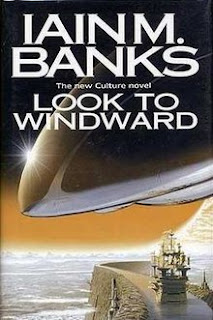
Iain M. Banks 'Look to Windward'
&
Talvin Singh 'OK'
I'll add some more present ones to this 'series' and see where it goes with whatever readings and listenings are prompted by my ongoing existence.
But, for the present moment...
I had noticed that some novels tend to drive my listening to a certain type of music
Indeed, that what I'm trying to do in these occasions is to continue or even heighten the feeling of the world being created in the novel with my own selection of music, much like a director does with the score in a film.
The very first time I noted this behaviour was when I was reading Iain M. Banks (The M. denoting that it's one of his Sci-Fi 'culture' novels) and the most apropos music was the excellent Talvin Singh album OK, particularly the 11 minute first track 'Traveller' which seems to fit right into the mood of Banks' world.
So, the first selection comes in the form of Scottish socialist sci-fi and musical Indian futurism...
Iain M. Banks 'Look to Windward'
![]() |
| (click image for description) |
&
Talvin Singh 'OK'
I'll add some more present ones to this 'series' and see where it goes with whatever readings and listenings are prompted by my ongoing existence.
Sunday, 9 December 2018
Sports on Sunday: Football Lads
Yesterday, 'my team', Chelsea beat Manchester City 2-0 at Stamford Bridge. During the match Manchester City forward Raheem Sterling reported that there was racist abuse directed at him from among the home supporters. That this is not surprising to me is much to do with the history of Chelsea's support, a portion of whom have been long acknowledged as violent racists. Indeed, like many firms, for them this is a badge of honour.
It has been a recent fantasy that since 1990 the 'bad old days' of hooliganism had been expunged from football. That it had instead been replaced with a family-friendly inclusive and modern way of supporting teams and following the game. Something that meant that 'being a fan' was paying for a Sky Sports subscription, rather than actually attending matches and experiencing the game itself. A more distant and impersonal attachment to sport, something that allowed for a global reach, that was more like marketing a brand, and was to many something that started to feel plastic and hollow. Football support, that is watching and not playing, is about the crowd and belonging. This is something that Bill Buford recognised.
'Among the Thugs' (1990) by Bill Buford captures a certain restless self-destructive energy that describes the society of the hooligan. A willing giving of the self to the crowd, to throw away individuality into a nihilistic ecstasy of frenzied togetherness. The wish to belong, to be part of something, and to feel that you are special in that. What makes you worthy is ironically that you have given up your personality for membership of the crowd, you have ceased being singular and are now part of a collective. That this collective is dedicated to violence is bizarre, irrational, even utterly foolish, but more than the collective wish to enjoy music or sport or be together in some ideological spirit, instead the hooligan embraces their outsider otherness, their wilful destructive hate. It is more enlivening, more thrilling, more real, because it is so anti-conventional. A line has been crossed. It is this 'line' that Buford seeks to describe in other crowd behaviours; the Yugoslav protest turned violent, the football crowd pushing themselves to cross the street, and in doing so make a physical sign that they have transgressed the rules of normalcy and that now, anarchy rules, the mob rules. Standard practice is being, temporarily, abandoned in favour of; self-abnegation, public destruction, social disorder, and the joy, the thrill, the excitement of violence. Whether an individual participant threw a punch or not, they were there when it all "went off."
Joe Kennedy's 'Games Without Frontiers' (2016) also points to another development in this resurgent hooligan attitude in football. That it is the working-class man's game and that the behaviours that they, the ultras, engage in are those that are 'true' to the authentic British male's experience. This experience rejects the hollow and plastic commodification of the game, but it also rejects the perceived middle-class gentrification of what is 'theirs' in another way. It labels the social improvements (as I would see it) of anti-racism, anti-misogyny, anti-homophobia (in short, anti-bigotry) as itself being unauthentic to the British working-class. A nonsense that effectively denies the fact that any working-class person could ever be anti-racist (f.e.) without being either a class traitor or a fake. So, something that started being about rejecting commercialisation of sport is now about the definition of what 'real' British maleness is, or at least, this is what the politicisation leads towards. And what counts as 'real' is the anti-feminist, anti-Islam, anti-immigration agenda of the far-right, which portrays itself as the 'real' voice of the working-class.
Racially abusing a black player on the other team therefore is, in this mindset, merely a case of a 'bit of banter', as it wasn't directed at all black players on both sides, it was just 'part of the game', just a bit of ridiculing the opposition and what if the middle-class PC SJW snowflakes don't like the language used, it's 'only words'.
Something that Buford also highlighted in his book was the attempted politicisation of these football firms in the 1980s by the National Front. He describes attending a gathering at a remote country pub that was organised by Nick Griffin. Then of the NF but who would later lead the British National Party to their, thankful, demise after a modicum of political success. However, although the BNP has dissolved back into the shadows. The people involved and, more importantly, their ideas did not.The attempts to hold influence over various different football firms coalesced into the English Defence League, which was founded in 2009 with 'Tommy Robinson' soon becoming the group's leader.
The Football Lads Alliance was founded in 2017, but represents only the most recent part of this ongoing politicisation of football fans, or more expansively, of the white working-class male. That this has also come on the rising tide of nationalism and of anti-Islamic feeling in Britain is no surprise. It was no surprise, because this has always been their intent. Our contemporary Nick Griffin, 'Tommy Robinson' is today participating in the Brexit betrayal march in London and like the attention parasite he is, this has particularly prescient timing. The ongoing 'yellow vest' riots in Paris (to which many in the far-right have added their support), and planned for only two days before a major vote on the future of Brexit in parliament. This march represents another attempt to infest one cause, Ukip's obsessive "Will of the people" hard Brexit, with the opinions and attitudes of the far-right.
Let's bring this back to the original case, which I see has now already turned into a 'one bad fan' story and carries with it the ubiquitous allegedly. It is also unhelpfully tinged by the excessive reporting on Raheem Sterling, who is a somewhat controversial figure in football, in that he seems to have opinions and the ability to articulate them (and he's black). Of course, it will be a simple enough matter to dismiss this as one rare occurrence and not in the 'true spirit' of the everyday fan. Well, of course, this is the case, it is not as if the far-right's opinion of the British working-class is in fact true. Worryingly though many other (non-working-class) people seem to buy into this depiction and (f.e.) blame Brexit on this stereotyped view of the thuggish racist working-class, something aided no doubt by sensationalist media coverage.
Certainly the attitudes and behaviours of many 'everyday' football fans don't help their case in the public eye, but then this is confusing an ebullient, albeit aggressive, atmosphere at football matches with something inherently dangerous. Much like the conservatives reaction to punk, or rock n' roll, or anything that seems counter-cultural (to them). In short, it is partly motivated by a fear of the working-class, something that only helps strengthen the far-right's attempts to show that they, the white working-class men, are the 'real victims' or other such falsehoods to gain recruits to their agenda of hate.
I will be writing more about Stephen Yaxley-Lennon AKA 'Tommy Robinson' and the recent soft coup of Ukip and the general 'crowd behaviour' dynamic of many online communities, but this story felt like it needed an immediate response and it's been a subject on my mind for some time.
P.S. Although this should really have been titled 'Secular Sunday: Football Lads' I couldn't resist.
![]() |
| Both are recommended reading. |
Sunday, 15 April 2018
Cult of Feelings
Love! π
We are good! ππ
They *urgh* are bad π & wrong π― & stupid π & misinformed πΉ &
'We' can't be criticised because
'they' can never be correct ---
don't be unhelpful, unconstructive,
leave behind your negative traits and doubts ---
only 'we' have the correct understanding
of the way the world is ---
'they' only want to stop and destroy
everything that 'we' stand for ---
If it feels good it must be good, feelsgoodman,
But only as long as 'we' think so too!
You wouldn't want to be like 'them'
Those are just 'bad' feelings, so bad, so sad,
So make sure that your emotive reactions ---
Have been properly pre-conditioned ---
And anyway, don't it feel so right to be good?
No wait, feel so good to be right?
Feel so right to be right
Be right
Be right
Be right
Time was you'd have to think real hard about things on your own;
How do I fit into the world?
What if I was wrong?
Who decides what is of value?
What is my place in society?
Are my decisions my own?
Is any of this real, what matters?
And all sorts of silly puzzles like that
Not anymore! Yay!
We'll tell you how and what to think to the point that you are practically indestinguisable from anyone else and isn't that what we all really want?
a Final solution
All you have to do is...
Leave you family
Give up 'certain' behaviours
Change your name
Stop bad thoughts
Alter what you eat/drink
Do not question
Give away all your money/possessions
Do what we say
Sacrifice your self when instructed
& doesn't that small price seem worth it?
Thursday, 17 November 2016
Thoughts on Thursday: Tabula Rasa
Presently I feel as if my mind has been swept blank,
& although there are no thoughts, there is a noise
an intense buzzing,
which comes in waves,
washing me further from the shores of feeling
into a deep cold sea, populated with monsters
King's spoil, dread with the undecided, blooded doomed
plunging gasping back towards the light, fearful as a newborn
. CFT 2016
![]() |
| Illustration by Mervyn Peake |
Sunday, 20 April 2014
Sonnets on Sunday: Wordsworth visits Wales
TO THE TORRENT AT THE DEVIL'S BRIDGE, NORTH WALES, 1824
HOW, art thou named? In search of what strange land
From what huge height, descending? Can such force
Of waters issue from a British source,
Or hath not Pindus fed thee, where the band
Of Patriots scoop their freedom out, with hand
Desperate as thine? Or come the incessant shocks
From that young Stream, that smites the throbbing rocks
Of Viamala? There I seem to stand,
As in life's morn; permitted to behold,
From the dread chasm, woods climbing above woods,
In pomp that fades not; everlasting snows;
And skies that ne'er relinquish their repose;
Such power possess the family of floods
Over the minds of Poets, young or old!
WILLIAM WORDSWORTH
Tuesday, 26 February 2013
TV on Tuesday: Revisiting Ultraviolet
Starting a wee bit of a theme this week of going back to old films, books, or tv series that I once enjoyed.
Series Link (Note: You must be in the UK and registered on 4OD, which is FREE): http://www.channel4.com/programmes/ultraviolet/4od
Thankfully Ultraviolet mostly escaped these concerns. Mostly. I'll return to the problems later, but first what made Ultraviolet enjoyable before still works now.
Despite being a TV series about vampires it is not campy, brooding, angst-ridden (at least, not with teenage angst) or over-the-top. Instead it is a very clever modern reinterpretation of the various vampire myths and gives a serious 'what if' explanation to the problems these myths create when faced with our contemporary understanding. For example: If vampires don't show up in mirrors, what about CCTV recording? Although, to be honest, I can't really think of a scientific reason why vampires can't be finger printed, which is a later consequence of this 'leeches cannot be recorded' policy. Still, it's a commitment and interpretation of the myths that is at least consistent.
Series Link (Note: You must be in the UK and registered on 4OD, which is FREE): http://www.channel4.com/programmes/ultraviolet/4od
![]() |
| The opening credits show a vampire-bitten body under UV light |
ULTRAVIOLET was a six-part supernatural detective series that aired on channel four in the UK in 1998, which I have some very fond memories of. Thanks to the online archive 4oD I was able to watch it again last week, actually the thanks should also go to JJ who searched it out.
Anyway, there's always a double apprehension watching something that one has 'fond memories of' with someone who is new to it. Firstly, that they will find it (and by extension you) reprehensibly bad/boring/stupid and secondly that you yourself will find that your memories were misplaced and that it has aged especially badly or that your earlier judgements were wrong or, at least, are now outdated and that it wasn't nearly as good as you've been giving it credit for.
![]() |
| (L-R) Philip Quast as Father Pearse J Harman, Idris Elba as Vaughn Rice, Susannah Harker as Dr Angela Marsh, and Jack Davenport as Michael Colefield. |
Thankfully Ultraviolet mostly escaped these concerns. Mostly. I'll return to the problems later, but first what made Ultraviolet enjoyable before still works now.
Despite being a TV series about vampires it is not campy, brooding, angst-ridden (at least, not with teenage angst) or over-the-top. Instead it is a very clever modern reinterpretation of the various vampire myths and gives a serious 'what if' explanation to the problems these myths create when faced with our contemporary understanding. For example: If vampires don't show up in mirrors, what about CCTV recording? Although, to be honest, I can't really think of a scientific reason why vampires can't be finger printed, which is a later consequence of this 'leeches cannot be recorded' policy. Still, it's a commitment and interpretation of the myths that is at least consistent.
That Ultraviolet represents the work of one person, the writer and director Joe Ahearne, means that it has a unity and consistancy of vision that is perhaps sometimes lost in productions with several or many writers. A comparison for further elucidation. To return to Utopia, a recent six-part channel four conspiracy thriller, which was billed as having a single writer, Dennis Kelly, but if one looks at the credits there are in fact many more contributors; based on original concept ideas by, script editors and supervisors, additional writing credits and so forth, all this means that it is not one script by one person, but a script that probably had multiple versions, many rewrites, and was subject to last minute changes, ongoing things that directors and producers would change. The Ultraviolet script, in contrast, seems as if it was much more settled and that each episode held its own story and linked to ongoing narrative points, shows something structured and well understood, that there is no danger of something or someone being mentioned then forgotten about and accidentally dropped. A possible failing to this unity if view is that minor inconsistencies or narrative mistakes that one person might overlook due to their closeness with the work would have been spotted by working with others. At any rate, this is pretty rare, but it does ask one to absolutely accept the artistic vision of the writer/director.
This is because Ultraviolet plays its supernatural elements totally straight. Indeed, the entire series is almost completely humourless (except accidentally, the nineties hair) and asks you, the viewer, to take it all very seriously. Something I'm not overly capable of. Still, it is the seriousness and thought to the medical and scientific (if not the social) aspects that help one accept this otherwise absurd logic. Indeed, it must be one of the only vampire-based series that doesn't actually call them vampires and treats the situation as 'normally' as possible. In this regard the programme plays much like a standard detective story, albeit with supernatural elements, with the main characters spending each episode tracking the activities of the code five's (code V, their name for vampires) and their willing, and no so willing, human servants in an attempt to reveal the wider conspiracy (i.e. what are the leeches up to?)
As the story is so simple and straightforward, it is the characters that must provide the main interest, with their various interactions, developments, and failings being vitally important. Thankfully, for the most part, there is a very strong cast. For example: Idris Elba's portrayal of the ex-army agent Vaughn is as a stock tough guy, and he has the least developed character, but he's so captivating on screen that it hardly matters.
Jack Davenport play Michael, who is the programme's main character. He is our way into the story and we stay with him as he tries to resolve the problem that got him connected with the shadowy CIB and their fight against the leeches in the first place. With such a central role, Jack must carry almost the entire weight of the series and thus it is with him that any blame usually stops. JJ's own critique of Davenport's performance was pretty damning, but she wasn't alone. A brief bit of internet research will normally show reservations about Jack Davenport's casting, usually describing it as one of the main problems with the show and perhaps they're right, but then perhaps this is because how the character is written rather than the fault of the actor.
My own opinion is that Jack Davenport's character must be too many different types throughout the programme. He is linked to to every main and secondary character, he is both loyal and contrary towards CIB, ambivolent and protective to his 'women'. In short he has mixed reactions to everything about him and everything in the show is related to him. Although mixed emotions are realistic, they don't play especially well for a central character that must carry the show. He is at one moment absolutely driven by duty and willing to risk his life, in another moment, he is oppositional to the authoritarian structure of the CIB and protective of his outside friends. Is he maverick or hero? It is this uncertainty (from the writer) that unsettles. Finally, for someone so conflicted and apparently so moved by emotion, Jack Davenport plays it very downbeat. This must be a directorial choice. We could blame the casting, but as Joe Ahearne had experience of working with Jack Davenport on 'This Life' I'd expect it was this that led to Ahearne building the role for Davenport.
It becomes apparent that Joe Ahearne means the character to be a maverick who is nonetheless also driven by his duty to the 'greater good'. Thus, a policemen seems a good choice. This character is better described in the other supernatural detective series that Ahearne wrote and directed, Apparitions, which starred Martin Shaw as a maverick catholic priest/witch-hunter. An actor who is well known for playing mavericks (Judge John Deed is almost the same character) and it's fair to say that Jack Davenport is not so renowned.
In closing, it was really great to revisit a TV show that I had such fond memories of and had not seen for at least ten years. I was pleased to see it has aged well (despite the hair and amusing mobile phones). Some good writing and a well structured script means that a production will always age very well. It's amusing to think how this show, if suggested for broadcast today, would be received by Twilight influenced producers. I'd expect they'd be horrified by the ordinariness of the vampires and lack of simmering sexual tension. I for one, however, am glad of that.
Tuesday, 19 February 2013
Television on Tuesday: Utopia - a quick review
Utopia is a soon to be finishing six-part British series that aired on Channel Four. I've just watched the first two episodes last night online and was moved to write this little review about my immediate thoughts.
At first impressions, it seems like it should have all the qualities that would make it, if not universally popular, then at least the sort of thing that is normally popular with me. I do like a twisting plot, characters that have a bit of substance about them (and are well acted), a bit of conspiracy, and some good old thrills and shocks. Now, while Utopia does have all these things, it still left me feeling rather empty. I wondered why?
The plot of the series seems like it is a homage to various British comic book series (the likes of Warren Ellis and Alan Moore spring to mind) and visually it seems setup in mind of large comic book panels with lots of one colour repeatedly being used (yellow, blue, purple, etc). That the entire programme begins in a comic book store (above, and note the name! very Alan I thought) and is about, indirectly, an 'insane' comic book artist is also no surprise.
So, it's got all this going for it. I thought the main protagonists extremely well-developed and well acted (especially enjoyed Nathan Stewart-Jarrett), but after watching the two episodes I had very little that really stuck with me. It all seemed very derivative and manipulative.
Indeed, perhaps due to its relation with so many other similar conspiracy thrillers (of various formats) I was able to predict most of the major events in both episodes (and minor, I called the 'mission accomplished' line five minutes beforehand) and not that I normally watch a programme trying to 'figure it out'. I enjoy a good film noir and let it take me along for the ride, I don't analytically observe and try and solve the mystery as if a type of puzzle. Anyway, that I fell into this mode with Utopia and was almost always correct in my guesses, I took for my boredom with the not-so-twisting plot. I'm really not one for mysterious all-powerful ex-government organisations that can kill indiscriminately and operate beyond the law (bored by Bourne).
Mostly what annoyed me was the predictably graphic, but not very graphic, violence. Violence used merely as a titillating shock is extremely repugnant to me. I'm not offended or disturbed by it (perhaps I should be... just another desensitised adult...) I just find it really rather lazy.
Would I watch any more? Probably not, but I wouldn't go out of my way to avoid it either. Could have been so much better.
Thursday, 11 October 2012
Theatrical Thursday: Noho Theatre Group & Beckett
An excellent and interesting little documentary about a Japanese theatre group (Noho) performing Beckett, described by director Jonah Salz.
The theatre styles Salz mentions are; kyogen and noh.
Beckett and Japanese Theatre - some of my musings
There is a sparsity and strangeness about both that seems to suggest some kinship. Indeed, although Beckett wrote in English, French, and German there seems still to be something fundamentally un-European about him. Perhaps it is his Gaelic/Celtic nature that is part of Europe but yet distant, culturally, from this also. Something alien among a wider society, like a cuckoo in the nest. Some aspect of Beckett's work always seems to be searching for a home or else suffering from some sort of home-sickness or world-weariness, what Freud called the uncanny.
Japanese culture for so long utterly isolated from the rest of the world (although we now respect this, but yet are suspicious of North Koreans for the same policy of voluntary isolation) and yet derived from the Chinese, developed something quite unique artistically in their retreat from the world.
What about the idea of intercultural theatre, is there something inherently problematic in the transposing of a play from one culture to another? We might not think Beckett such a problem, his plays were mostly devoid of any specific cultural references. Is the problem then applying a cultural paradigm to a playwright whose works were mostly acultural?
There's a problem with something being acultural, namely that we can't escape our context, or rather, we can't escape a cultural context. We might be transcultural (as Beckett was) but we are not denying (cannot deny) the cultural aspect (and it's influence). In a sense then all theatre must be retold from the current group and director's perspective, something imposed upon the playwright's original vision, even if they share the same culture. Although this difference would be less, but what a intercultual play might show are aspects in the original that were 'hidden' (now I don't really mean hidden, but that they were things one could not see without this version of the play) before. Intercultural theatre is therefore doing something no difference from setting a Shakespeare play in the 21st century, but it uses the cultural difference to highlight relevant features. What these are might vary from culture to culture.
Tuesday, 9 October 2012
Tuesday is Art News Day: Rothko Work Vandalised!
Please note: There's swearing aplenty below...
This
won't come as news to anyone, but as you all know a Rothko painting,
Black on Maroon (1958), was vandalised by Vladimir Umanets at
the Tate Modern last Sunday afternoon (7/10/12). Umanets argument is
that it is not vandalism but
an expression of his 'Yellowism', which is not an art movement as
such, but seeks to inspire (in part) the question, “what is art?”
Firstly,
am I worried or concerned that a great piece of art has been
potentially destroyed? No.
I'd
be no more concerned if the Angel
of the North was
scrapped or if the Mona
Lisa
were defaced (again). I suppose I'm just not that precious about art
works. I doubt Rothko would have been that bothered either. What
bothers me is; the nonsense Umanets talks, his ability to speak this
without contradiction, the lazy yet violent response by many people
against the vandalism, and generally the ignorant attitude many have
to contemporary art. So, that's quite a big and angry list.
Here
comes the rational argument bit...
1.
Umanets is or is not a vandal.
2.
Art works are precious and must be preserved.
3.
Rothko is or is not a great artist.
1.
Umanets is, from a legal definition, a vandal. However, beyond that
definition the question posed becomes one of value, or rather, the
value of the action. For example; was the man (Paul Kelleher, who was
subsequently jailed for three months) who decapitated the Thatcher statue in 2002 a vandal? Thus, the answer to (1.) depends on our
answer to (3.) it seems. If you think Rothko a fraud or conceptual
bullshit or whatever then you might not consider Umanets a vandal
(other than legally) but rather a saviour for common sense etc.
However,
and not just to shit in your porridge, I'd like to say that Umanets
is not a vandal, and that Rothko is a great artist, but that art works
do not deserve special treatment. Why?
2.
Now I'm not advocating slinging all art into the bin or storing it in
a shed, but that our sanctification of art is ridiculous. It stems
from the bullshit medieval religious power structures that art once
served, but that now it should be breaking away from and, further,
helping in the breaking down of. Art gallery's are like cathedrals,
where one silently and reverently gazes in mute and (most
importantly) passive
admiration at the beauty of the work and the skill of the artist.
Fuck
that shit.
Don't
get me wrong, I'm not going to hail Umanets as a hero, I think he's a
cretin with a nonsense self-aggrandizing agenda. One that the media
seem all to willing to encourage, mainly because they've lost the
ability to intellectually engage with and criticise events.
Anyway,
in one sense artworks are cultural artefacts or icons and for the sake
of history they should be recorded.
This does not mean the individual object must last forever as an
undamaged relic for us to place in a reliquary and worship but most
importantly for the rich parasites to buy and sell. It is for these
parasite fucks financially worthwhile to keep the 'art is something
distant', 'art is something special', 'art is something holy'
worldview alive. To keep art as a tool for the (rich and) powerful, thus
increasing it's value.
Before
returning to Umanets and the nonsense of Yellowism, I'll briefly
cover 3. Now, I'd like to write a longer piece about Rothko, but
let's do that separately and once I've spent some time properly
viewing his works and not just as a reaction to this. I claim that
Rothko is a great artist, but what makes an artist great? Paintings
valued at 50 million plus? Not to my mind. What is it that makes an
artist great or good or worthwhile? I believe the answer must be in
their depth of vision. Something Rothko has, but more than just this
it is their experimentation with ideas, their attempt to investigate
something, to have an ongoing intellectual/artistic development, to
try and say
something
that makes it worthwhile.
In
conclusion, my lack of concern about (2.) means that my finding
Rothko a great artist (3.) is unimportant, but I though you'd like to
know that I do think Rothko worthwhile. I only mention this to
contradict a lot, of what seems like, amusement with the damaging of
'modern art' something that most people (are told, by the tabloid
press) dislike. An example of which is found on the satirical British
website Daily Mash, I find the Daily Mash's response to be just too
close to what a lot people think to be really funny. Actually, that's
a lie, it's still funny. I laughed. I suppose that a Conservative
reaction would be; Umanets is a vandal (broke a law), Art is precious
(historic legacy), Rothko is not a great artist (modern art is
rubbish). A Liberal 'art-lover' would react; Umanets is a vandal
(defaced art), Art is precious (humanity's greatest achievement),
Rothko is a great artist (apparently, have no reasons for this, but
must
be).
P.S. Compare and contrast...
That's not a knife [vandalism], THAT'S a knife [vandalism]
Guardian_video
BBC_article
Crocodile Dundee
P.P.S.
I've just remembered that when David Nash's piece Big Bud was vandalised he remade it into Charred Cross Egg. Perhaps, because he was cross? Sorry, being silly, but he didn't try and restore it. What Rothko would do were he alive is a matter for speculation. Any guesses?
A
response to Umanets in closing. It is obvious that he is legally a
vandal and will probably get a three month sentence for this, in that
he has damaged someone else's property. Much like if he stole your
bike or pissed on your rug. Is art property, that is, an own-able
valuable object? Under our current considerations, yes, obviously,
but do I think that this should be the case? No. Should people be
able to damage existed artworks just because they don't like them or
they want to force a bullshit manifesto upon the world? I think the
answer must be that you should not damage something simply because
you dislike it, but perhaps because of what it represents (Thatcher
statue). This doesn't mean Kelleher was right, but we should be able
to voice our disgust with works like that (and if we're not, perhaps
then destruction is allowable). Rothko's work was chosen arbitrarily
(it seems) or perhaps only because of the artist's controversy (i.e.
'is it art?') or the object's value. Should we allow Umanets the time
to voice his bullshit, simply because it's entertainment for the
media? Not without an intellectually rigorous response, which is not
yet forthcoming. That is to say, allow him the space to show how
limited his Yellowism is, not celebrate his childish outburst. That he, an idiot, knows how to manipulate the media to get his daft message across is a laughable damnation of our culture.
P.S. Compare and contrast...
That's not a knife [vandalism], THAT'S a knife [vandalism]
Guardian_video
BBC_article
Crocodile Dundee
P.P.S.
I've just remembered that when David Nash's piece Big Bud was vandalised he remade it into Charred Cross Egg. Perhaps, because he was cross? Sorry, being silly, but he didn't try and restore it. What Rothko would do were he alive is a matter for speculation. Any guesses?
Tuesday, 2 October 2012
David Nash at Kew: Art exhibition review
David Nash is a British sculptor, well known for his large outdoor works almost exclusively in wood. Nash is currently artist-in-residence at the Royal Botanic Gardens, Kew. David Nash was born in Surrey in 1945, but has spent most of his working life based in Wales. I'd suggest that this time in Wales, in rural North Wales specifically, has helped shape his understanding of the natural environment, an understanding that is shown in his art and how he talks about his work in interviews. To my mind the Welsh landscape is undeniably beautiful, but it is also hard and rugged, it is a working landscape that bares the marks of the struggles to make a living throughout Welsh history. It is not therefore a landscape merely of 'scenery' but of living and working, of 'doing'. The slate tips that dominate the locality of Blaenau Ffestiniog, Nash’s adopted home, testify to this history. There is a practicality about this natural connection, fostered in this worked landscape that removes the potential for a pseudo-shamanic interaction, for Nash the spiritual is part of the physical; there is a combination in activity. As Nash says in an interview of 2001, "There is no shamanism. You can bring those associations to them, but my concerns are fundamentally practical. The spiritual is dovetailed into the physical, and the two are essentially linked with each other. To work the ground in a practical, basic commonsense way is a spiritual activity.”
Nash is often connected with Land Art, but this is itself problematic, as Land Art is no movement or anything as definable as an 'ism'. There are several fairly distinct strands and Nash could be described as taking part in a different approach, one that Ben Tufnell (in his excellent book Land Art) calls 'Working with Nature', that is, with growing art and planted projects like the ongoing work Ash Dome. Although denying the spiritual and ritualistic dimensions in his work (as employed, for example, by another 'working with nature' artist Chris Drury) there are definite and purposeful social and political aspects in Nash's work. The Ash Dome, for example, created/planted in 1977 was at a time of specific political upheaval and serious economic gloom in the UK when the threat of Cold War and nuclear annihilation seemed very real. The work is then a gesture for something for the future, when our focus had become so based in the short-term; the Ash Dome makes a commitment to the future, one with “an extended duty of care, a constant need for tending.” (p.91, Land Art)
His ambition also has a certain Walden element to it, as quoted in Tufnell 2006: “I want a simple approach to living and doing. I want a life and work that reflects the balance and continuity of nature. Identifying with the time and energy of the tree and with its mortality, I find myself drawn deeper into joys and blows of nature. Worn down and regenerated; broken off and reunited; a dormant faith revived in the new growth of wood.” (p.88)
This want, to ‘get back’ to the simplicity of nature isn’t especially new; we can see the traces of it in the Victorian morality of authors like Thomas Hardy, as well as Thoreau and many others, but it isn’t the age of the desire that is incongruous, rather it is the crypto-spiritualism of transcendence, the rejection of the practicalities of the world and of civilization that is striking. At once it seems to make the human un-natural and alien, it starts to distance the practical as a tool of anti-nature, but this paradox should be handled carefully. When Nash began to develop his green art, he only used natural or traditional tools, carving the tree slowly by hand. This reverence for the traditional arts would seem to emphasize the rejection of modern technology and if he had kept this approach one could see him slide towards a pseudo-shamanic ritual, however, Nash nowadays (and for some time) makes full use of all modern equipment and technology, sculpting his works using a chainsaw and using iron and bronze cast foundry pieces. Further, Nash makes an effort to show that the direction of the work is forward looking, with an eye on our future, one we share alongside and working with nature and that “we cannot separate ourselves from the natural world. Our actions, from everyday activities to essential industrial work, have an impact on it. My work invites the same consideration.” (From David Nash at Kew Gardens, 2012, p.7) It is perhaps a mixed message that Nash seeks to convey, certainly it is one that is laden with much ideological baggage, but it is this perceived questioning of man’s place in nature and of the relationship that seems to make Nash an appropriate artist for Kew Gardens.
![]() |
| A Map of Kew Gardens with the Sculpture locations |
Kew Gardens is more than a visitor attraction. It, like Nash, is an amalgamation of contrasting ideals. One the one hand it is a Victorian hangover, a green cathedral that promotes a reverence of nature, and on the other it is a very contemporary place of active horticultural science, indeed, with the ark-like Millennium Seed Bank it also a store of science. There is an artificiality about Kew that seems to separate it from Nash’s work. It is a created display with plant species gathered from all over the world; and as such it represents a kind of plant zoo, as there is something distractingly out-of-place about a polar bear in London there is something like a lesser effect with the Gardens (this perhaps due to the fact that almost every British garden is something like a junior model to this Victorian monolith as it also contains so many foreign species). However, the effect is still there, this is not the practical worked landscape of Wales with its naturally occurring (although humanly cultivated) ash trees. Here then is the conundrum- at what point does human interaction become unnatural? Despite all of Nash’s attempts there is still an acceptance that the natural world must be shaped in some manner if we are to change it for our ends, it cannot be persuaded and we must accept responsibility, for it is we who alter for our own ends. This is something that Nash’s rejection of shamanism can achieve, with a spiritual focus to the work we find ourselves constantly shifted away from an immediate connection with nature (or art for that matter).
Nash's exhibition, which runs for nearly a year, is displayed in situ among the fantastic landscape of the gardens themselves, where he is also using the dying and dead trees of Kew to create new works. So, this is not just a retrospective of old works, but a collection of new works created from the gardens, using trees that have come to the end of their natural life. The illustration below shows how Nash operates his ‘Wood Quarries’. The sketches he makes have been compared to that of a butcher, with different ‘cuts’ representing different sculptural works.
I submit for consideration that it is this ‘butchering’ of the trees that some have found so rough, barbaric, and distasteful. This is because it goes against the reverent romanticism that many have for nature, or rather, for how we should appreciate nature. Perhaps then Nash is showing another way of seeing nature, not merely as an industrial product, but not as a distanced spiritual object either. To my mind this sort of falling our between Nash and the critic originates in a failure to grasp his concept of nature. Now, I would say that this is in no small part due to the locale, which muddies the waters, but it could also be the viewers own Romantic predilections (if any) and what (for them) constitutes proper art.
![]() |
| Charred Cross Egg. Brutal or beautiful or something else? The work is a development of an earlier work, named 'big 'bud' that was vandalised. Pragmatic rescue or not? |
For many this won’t matter, they are striking objects in their own right anyway and loom in the landscape as do many public artworks, but this too is a problem, this is not ‘public’ art rightly considered – it is not made to decorate a building faΓ§ade or plaza – but it is natural art made to bring us into the landscape and consider one’s relationship with the natural world. Thus it is best kind of conceptual art, it is more than just an idea loosely configured or an art object devoid of further thought, rather it is a something that asks questions of the viewer and demands something back.
![]() |
| Black Trunk. Mirrored against the Kew pagoda it makes mankind's efforts appear rather fragile. |
And yet, it is not just the juxtaposition with Kew that distorts the message. One might ask the works themselves for a continuity of this message and find them lacking. Nash has in the past (1994, but earlier versions exist) drawn up a ‘family free’ that shows how his works have developed, branched off, and grown. Rather than an explanation, this looks like an excuse, or worse, being caught red-handed trying to impose a later thought of order by retrospectively narrativizing one’s own life and work.
![]() |
| A section of Nash's 'Family Tree' |
That Kew is hosting a Nash exhibition is something that places Nash as one of British art's grand old men, a person of renown and 'a name'. Certainly it is something that will make him better known to a larger amount of people by being at such an iconic location. That his work is defined by its relationship with the natural is something that I deeply appreciate and hope that some aspect of this message is conveyed. However, I am also sceptical of the clarity of the message and the method of conveyance, that is, the art works specifically in the location of Kew Gardens.
![]() |
| King and Queen I. This title is too distracting, on first viewing it was much more impressive without. |
After viewing Nash’s work you cannot help but look differently at the natural surroundings and perhaps Kew itself emphasizes this effect. And this is perhaps the best compliment one can pay Nash’s work, for all its failings, that there is a type of artistic seeing that comes from repeated viewing, it gives you another perspective on the ordinary world around, makes you think again about the arrangement of nature, wondering about our impact and our meddling, all art, all good art gives us this, but perhaps in different types and/or manners.
![]() |
| A collection of the works in the temperate house. From top left: Plateau (2011), Crossed Egg (2002), Red Frame (2008) |
Works:
David Nash at Kew Gardens (Kew, 2012) - All images used
Ben Tufnell, Land Art (Tate, 2006)
Saturday, 7 July 2012
Friday, 22 June 2012
Thursday, 21 June 2012
Sorry
Sorry
by R. S.
Thomas
Dear
Parents,
I forgive
you my life,
Begotten in
a drab town,
The
intention was good;
Passing the
street now,
I see still
the remains of sunlight.
It was not
the bone buckled;
You gave me
enough food
To renew
myself.
It was the
mind's weight
Kept me
bent, as I grew tall.
It was not
your fault.
What should
have gone on,
Arrow aimed
from a tried bow
At a tried
target, has turned back,
Wounding
itself
With
questions you had not asked.
Subscribe to:
Posts (Atom)