Creative Commons License

Showing posts with label Freedom of Speech. Show all posts

Wednesday, 9 May 2018

Final Verdict: Dankula - Who Means and Who Memes

So, as mentioned, here is my own final verdict concerning the case of Markus Meechan. To be very brief, it is both better and worse than I had first considered. Something I was already aware of, however, was the fairly reprehensible behaviour of the British 'free' press. Whose style is more about sensationalist entertainment over objective facts, in short, it is an approach that is more tabloid.

James Matthews, Sky TV Reporter: You said 'Gas the Jews' 23 times, what's funny about that?
Markus Meechan AKA Count Dankula: The context of it. It's the juxtaposition of having an adorable animal react to something vulgar.
MM: That was the entire point of the joke. Have you seen the video?
JM: Do you accept you committed a crime?
MM: Have you seen the video?
JM: I have.
MM: Alright again, so I've explained the context of it so why are you asking me that again?
JM: Well, the context is that you've been fined £800 for a crime that you've committed?
MM: No, report under the context of the video. Don't try and move on me.
JM: We have in court that you committed gross offense against a large community of people.
JM: 6 million Jews were killed in the Holocaust.
MM: You just said the statement a couple seconds ago.
MM: Why should I consider your context if you're not concerned with mine?
JM: You've broken the law, do you regret breaking the law?
MM: You just broke the law two seconds ago when you said the phrase.
MM: Remember context matters mate.

Above is a transcript of a journalist attempting to perform a 'gotcha' interview on Meechan just as he was leaving Court after sentencing. Meechan's point isn't particularly earth-shattering, but it's telling that the journalist has no comeback. Mainly because he really isn't that interested with the 'news' he is reporting, just doing his job of humiliating people for entertainment.

Here's my brief comeback to Meechan on the above point, but just be crystal clear I'd like to point out that I think the 'journalist' is behaving shamefully. Context, however, is not just the structure of an idea (in this case, the 'point' of the joke), it also refers to the 'social' environment. This is, after all, what the judge felt was sufficient grounds to find Meechan guilty, the social environment of anti-Semitism. Whether this was a correct assessment is another matter, and one we'll return to.

Below is a video of Meechan giving his response to; the trial, the sentencing, and the situation around it. I think he comes across as a fairly observant and thoughtful, if flippant, person.

https://youtu.be/5VDfcrDHvzE


[After watching the video, I left the following comment directed at Meechan]

Did I like the joke? No.
Do I think you should have been arrested? No.
Do I think this is a dangerous precedent for freedom of speech? No, not really.

Here's why. You said that the court disregarded your 'context and intention'. I don't think that's correct. They heard your version of context and intention and the judge disagreed, now perhaps this is a sign of a conspiracy to stop free speech, but I think it was just one legal decision. I mean, they haven't changed the law in response have they? A different case would be treated as that case.

So, do I defend your right to make s****y jokes? Yes.
Did you make a mistake publishing the video on YouTube? Possibly, but people make mistakes.
Do you deserve to get punished for people being 'offended' by that? No. YouTube does, if anyone does. All they needed was a 'click-through' warning.

This should be unifying people of all political beliefs not dividing them, but it is also not the case for allowing ALL speech. Free speech doesn't mean saying what you like without consequence, but we all mostly know this. As you say, Context matters!

Does this mean that governments should police individuals on the internet? F*** no.
Police the companies instead. Maintain the context itself.

Although I can say whatever I like in private without fear of repercussion, it doesn't follow that I should be able to say the same thing in public UNLESS we are using our free speech to criticise; the corruption of institutions and public figures, societal structures and injustices. This includes satire, art and comedy in general.

I think the real problem is that the lawmakers have no idea how the internet operates and so we get this reactive nonsense right now. I think that in a few years when those setting the laws and policies are 'like us', that is, grew up in this internet age that it will all (hopefully) quieten down. Doesn't mean we should be silent though, they don't know it's wrong or over-reaching if people don't tell them.

[I've edited out my own 'jokes' from the comment because they're not that funny. Below, is a response that although making incorrect deductions is representative of the general feeling]

A man made a joke and was fined 800 pound[s]. So it's a very dangerous precedent for freedom of speech. It's as black and white as that - if we start policing what people say then eventually the only space you'll have is the four square inches in your head.

[I wrote a reply to the comment, which if I get another response that is similarly useful I will also include and reply to, but here's my first answer]

Well, that's the thing isn't it. You say, "made a joke" and the problem is, comedy is an art form and therefore subjective. Law deals with facts. What were the facts of the case? That some people found it "grossly offensive?" I'd argue that this reaction is as subjective as the definition of a joke and is therefore not the grounds for a legal case. The legal grounds would be that it "incited racial hatred" or something along those lines. And did it? No. Could 'comedy' do this? Yes. Nazis make jokes too and they are bigoted lies masquerading as jokes. Being comedy isn't and shouldn't be a 'get out of jail free card'.

It's not a black and white issue, indeed, I'd suggest that almost nothing ever is. Just because you agree with something doesn't make it right. How is this a dangerous precedent? Do you really think this is the first step to an automated totalitarian police state? We already police what people say, that's why Abu Hamza was arrested or do you think we shouldn't have done that? (It took long enough as it was) Total freedom is impossible, it's about deciding what should be allowed. Should 'bad taste' jokes be allowed? Yes, I think we should be able to make them. Context depending, of course.

As I said, I think the problem is that those making the laws are so out of touch with the internet, the culture on the internet, and the sense of humour on the internet.

Is this part of a larger conspiracy? No, calm down, it's not. Doesn't mean that people should remain silent in the face of unjust decisions like this, but let's not start another moral panic. The internet's a great place for ramping up irrational concerns, sometimes people just need to stop and think, like they would in a 'real world' situation (paranoiacs notwithstanding).

I like the idea of a protection body for free speech, because it's the 'small' people that are getting done by this. They picked on Meechan because they thought he was small, they hadn't counted on the support he'd get. There were 'moral panics' (from the press mostly) that threatened Frankie Boyle, Chris Morris and other comedians before, but they backed down because of the public outcry.

But then, are we talking about ALL free speech or just comedy/satire?

***

This Forbes article is by far the best that I've read on the subject, as it offers constructive criticism of the law and Markus' own behaviour, which I also claimed wasn't helping his case. It also details the judges own lack of knowledge of internet culture, even of the basics of how the technology operates.

https://www.forbes.com/sites/fruzsinaeordogh/2018/04/30/a-nuanced-take-on-count-dankulas-nazi-pug/

In a reply to the author, Fruzsina Eördögh, Meechan spoke of,
"a huge discussion in our circles right now" about the notion of "who means and who memes." To explain it in the context of this post, how popular Internet memes have been co-opted by hate groups and the mainstream and it is becoming increasingly difficult to tell who is being ironic and who actually means it.

Whether this 'discussion' is to be truly believed depends on how much of a conspiracy theorist you are. I have some faith in human nature and therefore hope that both the Scottish Courts and Meechan's circles are not actually part of a convert plan to undermine democracy via totalitarian thought control or by fascist infiltration into mainstream. It's worth keeping an eye on however...

***

Thanks to the UK's internet super-bureaucracy I was able to find the judge's sentencing comments in the Meechan trial. http://www.scotland-judiciary.org.uk/8/1962/PF-v-Mark-Meechan

The document contains several interesting comments, not least this statement in the closing section,
This trial, unusual though some aspects have been, was therefore concerned, ultimately, only with the narrow fact-based question of whether the Crown has proved beyond reasonable doubt that your using a public communications network on one day to post the video onto your video channel, constituted an offence contrary to section 127(1)(a) of the Communications Act 2003. I found it proved on the evidence that it was. My finding establishes only your guilt of this offence. It establishes nothing else and sets no precedent.

So, we can take the Sheriff Derek O' Carroll at his word as a member of the judiciary of Scotland, or we can consider him a conspirator in a devious plot, as I say though, I remain hopeful about human nature.

What struck me, and this is mainly due to my lack of attention to the nature of the case itself, was that the sentence was under the Communications Act 2003, Section 127, which is not about 'freedom of speech' or 'hate speech' but instead related to the 'improper use of public electronic communications networks' and has typically been used to prosecute people who make threatening or offensive comments on Twitter and Facebook.

Below is the legal definition from the UK Government website.

https://www.legislation.gov.uk/ukpga/2003/21/section/127

And here is an article on the Communications Act, detailing some of the cases (including Meechan) and some of the ongoing problems with the law. Most notable the definition of 'public' in the public electronic communication network. At this stage, the use of public is to describe that they are free to use and open to view, although this has already be disputed and is open to interpretation.

https://wiki.openrightsgroup.org/wiki/Communications_Act_2003/Section_127

For me, this raises some issues with the Meechan case itself, as I had previously thought he was being tried under hate speech laws (Crime and Disorder Act) and although disputable that at least made some sense. By using the Communications Act 2003, I am immediately drawn to the parallels with the Paul Chambers 'Twitter Joke' Case in 2012. Chambers was also first convicted and ordered to pay a fine (also losing his job in the process) and he subsequently successfully appealed his conviction in the High Court (albeit at the third attempt). So, things are looking good for Meechan. Although perhaps he should go for the support of people like Stephen Fry and Al Murray (who supported Chambers), rather than Alex Jones and 'Tommy Robinson'.

https://en.wikipedia.org/wiki/Twitter_Joke_Trial

Concluding Remarks

1. As I said before, it's not illegal to choose 'bad company' or to be a rude c*** nor should it be illegal to make jokes in 'bad taste'. Meechan achieves all of these things; he is unlikeable (from my POV), he associates with 'less reputable' YouTube personalities and 'activists', and he makes crass childish 'jokes' at the expense of others. None of these things are against the law, thankfully.

2. Eventually, we'll come to see that too much internet usage is a bad thing, like drink or other drugs, and maybe this generation of sh*tposters will be the ones to teach us that.

3. We do need to be able to challenge laws that are being badly executed or improperly used. We also need to watch that our challenges are brought about by logic rather than a moral panic. If we look at the law and how it is being implemented, I would hope that it would alleviate the concerns of the UK becoming a police state or any other far-reaching rumour mongering, but such analysis would also show that there is an absence of a decent conversation about freedom of speech in public and that sometimes the law makers are acting without sufficient thought or knowledge of the area that they are dealing with. This reminds me of this statement by O'Carroll in his summing up, "although I invited both legal representatives to make legal submissions during the trial about the law on freedom of expression, that was done only to a very limited extent. In the absence of focused submissions on that topic by either the Crown or the defence, all I can say is that, while that right is very important, in all modern democratic countries the law necessarily places some limits on that right."

So, rather than finding this case as a reason to further spread irrational fears on the internet, let it instead be a reason to ignite a public debate of what freedom of speech means to us all and why that might be important and not just another piece of sensationalist entertainment 'news' that will quickly be forgotten.

Monday, 23 April 2018

Meanwhile in Deutschland: die Redefreiheit

April seems to have become an impromptu 'Free Speech' month for me, so I couldn't really ignore this story from the BBC Trending...


http://www.bbc.co.uk/news/av/stories-43831620/is-a-new-hate-speech-law-killing-german-comedy

So, for those of you that are unable to watch this news video I will make a brief précis, otherwise skip ahead to the second section.

Sektion Ein. "Is a new hate speech law killing German comedy?"

The new German hate speech law, which was passed last year, requires companies to remove 'hate speech' from their social media or face huge fines.

Sophie Passmann is a writer and radio host who works for satirical late-night talk  show Neo Magazin Royale. After last year's annual presentation of 'Dinner for One', a German New Year's institution, Passmann posted this comment of twitter:
"As long as it's tradition here to watch Dinner for One on New Year's Eve, refugees are welcome to come here and destroy our culture."
Passmann explains that the subject of the joke was those people who really believe that refugees do indeed 'destroy culture' which she believes is a stupid position. However, due to the language involved, the comment was flagged by Twitter and she was informed that it would be deleted to comply with German law. However, after a few days being headline news, Twitter reversed their decision and the tweet was allowed back online.

Similarly, the cartoonist Schwarwel had a cartoon withdrawn from Facebook for using 'offensive language'. His cartoon was intended to mock the recent H&M controversy and had used a racial slur although he had put it in the mouth of a member of AfD, a right-wing German political party. After complaining to Facebook himself, Schwarwel was told that it was not due to the new German law and had been taking down 'in error'. Facebook responded when questioned about how they are implementing the new law:
"Facebook reviews every NetzDG report carefully and with legal expertise, where appropriate. Facebook is not pursuing a strategy to delete more than necessary."
Although another comedian, Michel Abdollahi, thinks that although Passmann's tweet did not deserve to be removed that the law is worthwhile otherwise. Although it is not perfect, it will develop over the next few years, but that the intention set out by the law is something important.

The German government has said that it is open to re-evaluating the law in a few years if needed.

Sektion Zwei. Language is not neutral, but computer algorithms are.

The problem here is that Passmann's comment can be read in either way, if you are not familiar with the context, her comedy style, or other factors. Admittedly, it only takes a short examination to determine that there was no malicious intent, however, Twitter (standing-in for all of social media in this example) does not have the luxury of time nor of analysis. Their system works based on a strict interpretation of the law and is flagged to them by a computer algorithm that searches for uses of particular phrases and words (I would assume).

I think it is unlikely that they review each individual case of deletion, unless it is brought to their attention, i.e. via news media. This seems a massive waste of time, until we consider that (1) if gives the press something to write about and better yet, something to complain about, and (2) it does the job of highlighting what was actually an innocuous tweet or attempted joke from those that are not for Twitter, saving them the time/money of employing a real person (or team of people) to 'filter' through these comments and make a perspective judgement on the language being used.

Concerning Schwarwel's cartoon, when is an ethnic slur a joke? Part of the problem here is that the use of certain words and phrases elicits an immediate negative reaction, one that can forerun and overtake any other intention in its use. This, indeed, is the wider problem in continuing to perpetuate the language of bigotry, even if the intent is to somehow undermine or devalue its usage, it requires more than simply repeating the stock phrases of racists.

The law is a blunt instrument. Although the onus is placed upon the law to mediate each situation correctly, ultimately it cannot, in much the same way as the algorithms of Twitter and Facebook merely flag 'inappropriate' language without being able to interpret the contextual use of that language or worse relying on users flagging offensive content themselves (those 'reporting' might have ulterior motives beyond simply civic duty). The final responsibility must fall with those using the language, both at an individual and societal level.

It is a failing to merely reflect the responsibility back to the law and say that if you want free speech you must also accept hate speech. I have already agreed with the folk wisdom, 'there is no right not to be offended' but there is also no right to say whatever you wish in any situation without consequence. To be part of a free society means making certain allowances, agreed behaviours, and drawing limits for tolerance. All within it's context, of course. This should be an ongoing discussion, democratically.

Finally, in this story there is an unstated assumption about Germany that I know British people and I would suspect others make also (especially Europeans and Americans). It is that Germany has more reason to implement laws of this nature due to their recent history, which is often used as a way of excusing our own nationalistic/imperialistic crimes of the past (of which the UK has multitudes, indeed, all nations do). This is a worryingly restrictive viewpoint, as it casts one nation as the 'wrong-doer' and the other (ourselves) as the moral 'hero'. Sadly the reality of our ethical natures is far muddier than fiction paints it, again, this acceptance/realisation relies of responsibility both individual and social. Something that Germany have taken the first step towards. Viel Glück!

Sunday, 15 April 2018

Cult of Feelings

Love! 💖
We are good! 🌈🌟
They *urgh* are bad 💀 & wrong 🚯 & stupid 🙅 & misinformed 👹 &

'We' can't be criticised because
'they' can never be correct ---
don't be unhelpful, unconstructive,
leave behind your negative traits and doubts ---
only 'we' have the correct understanding
of the way the world is ---
'they' only want to stop and destroy
everything that 'we' stand for ---

If it feels good it must be good, feelsgoodman,
But only as long as 'we' think so too!
You wouldn't want to be like 'them'
Those are just 'bad' feelings, so bad, so sad,
So make sure that your emotive reactions ---
Have been properly pre-conditioned ---
And anyway, don't it feel so right to be good?
No wait, feel so good to be right?
Feel so right to be right
Be right
Be right
Be right

Time was you'd have to think real hard about things on your own;
How do I fit into the world?
What if I was wrong?
Who decides what is of value?
What is my place in society?
Are my decisions my own?
Is any of this real, what matters?
And all sorts of silly puzzles like that
Not anymore! Yay!
We'll tell you how and what to think to the point that you are practically indestinguisable from anyone else and isn't that what we all really want?
a Final solution

All you have to do is...
Leave you family
Give up 'certain' behaviours
Change your name
Stop bad thoughts
Alter what you eat/drink
Do not question
Give away all your money/possessions
Do what we say
Sacrifice your self when instructed

& doesn't that small price seem worth it?

Wednesday, 11 April 2018

Further freedoms: Comedy, Defamation and Truth in Art

Continuing from the discussion on comedy and offense, I recently found out about the stand-up comedian Louise Reay getting sued by her ex-husband, for a stand-up show about totalitarianism and the Chinese government that included a joke or 'bit' (apparently two minutes of material in a fifty minute show), that the ex-husband took offense to and is therefore suing her for defamation and breach of privacy.

I’m conflicted about this, because I do see the argument against controlling what people can say, but there’s also the impetus on the person to take personal responsibility, to check what they’re saying and how it might be interpreted or the context it is used in, but then you might say, “How could anything be shocking or new or provocative? What’s wrong with someone being purposely vile?” Some performance art, made to outrage sensibilities is actually a good thing (and considered great art) it’s pushing us towards something else that shows a different perspective. The problem is that we don’t know if it’s worthwhile, so we shouldn’t stop it (before it’s time), unless it is 'obviously' offensive, but then maybe someone’s overreaction to a lewd joke might comparable only on a scale to the reaction to want to ban what are more rightly considered offensive images like child pornography.

Some see banning topics from public discourse as being “just like the Nazis” and totalitarian itself, but this is a weak argument I would suggest. Being stopped from making racist remarks isn’t the same as being a fascist. The argument though is to stop language that is not merely offensive (that is itself not illegal and I would agree in defending the right for people to actively use offensive language in context) but that it also leads to directly or indirectly effecting another's personal safety, well-being, or advocates removing their human rights. That is to say, it is not just your opinion that what you have heard is offensive (a perspective) but rather that it can be shown or proved to have been meant deliberately to help (directly or indirectly) disadvantage you or place you in a situation that results in marginalisation, discrimination, or encourages other negative bias and potentially violence.

However, the ability to see how negative language or 'just words' could lead to more than just hurt feelings is apparently incredibly difficult for some people. Perhaps this is the privilege that the Left are so often talking about?

Take your pick of recent or not-so-recent examples of 'borderline' racist language being used, I'm thinking of the recent Heineken advert controversy, but you can use your own. The response to this tends to go a little like this:

“Why’s this racist? I’m not black; therefore I cannot see why it could be racist.”

This is normally the first step towards the very common response that you can find all over the internet in just about every comments section:

“People just get offended. People are too easily upset.” (on purpose, i.e. they are acting or exaggerating).

Which is, actually something that I would agree with, because those people that are too easily upset include the people who feel the need to go on the internet to complain and say, “Well I’m upset that people are too easily upset, it’s upsetting to me how easily upset everyone else is. I take offensive in other people taking offense.” And so on and so on.

People have different backgrounds, different worldviews shaped by their experience, maybe have similar experiences and come up with different responses because of their backgrounds and because they’re wrong... no, because they’re different people. They are sometimes wrong, obviously, when dealing with a matter of definite facts or logical analysis and they just haven’t done that, they’ve just gone with the gut. Hence, a lot of our current problems, are caused by people just are going with the gut. For example, off-the-cuff political remarks that would previously have been challenged are taken as political fact.

The threat to free speech is not; from the Right’s perspective the Left, and from the Left’s perspective the Right, because when everyone is too busy slinging mud at each other and not looking at the laws, then nothing’s really getting challenged, then the laws keep changing, at the time no one seemed that concerned about the Snoopers’ Charter, and this gets us back towards the heightened level of control and influence a certain few companies (Facebook) have over our lives, either directly (via advertising) or indirectly (influencing political parties and media).

But to return to the initial topic that we have more direct contact and control over.

Reay's offensive language, that ‘attacked’ her ex-husband, was part of a comedy show, it was intended as entertainment. The insult was already part of the performance. Did this include private data? However, this has now been removed from the routine in agreement with the ex-husband's lawyers and no copies or recordings have been made so it no longer ‘exists’ and we cannot answer this.

If we’re going to say that the ex-husband should or does win the court case, does that mean that you can’t insult anyone in a stand-up show, without some sort of consent? His argument could be, “she didn’t ask me whether I wanted to be referenced/used as material in the show.” So, if I sit in the front row and a stand-up makes fun of me for looking like a twat (fairly likely, as I do) can I then sue them? Or would it instead be thrown out as I choose to be at the show, and that’s consent to participate, which that seems fair.

What about offensive jokes about a wider general group? Jokes about; Muslims, Jews, Gays, Blacks etc. Could you as a member of one of those groups sue the comedian for not asking for your personal consent? Who gives the consent for a joke about a religion, or a country, or ginger people, and who’s making that distinction? Without the possibility of consent given at a singular level, does this mean we should be more or less sensitive about the jokes we made and the language we use? Well, not to sound like a broken record, but context is the guide. Calling a collection of developing countries "shitholes" for example, is different when one is the POTUS than when one is not. Indeed, one could think of a situation where that phrase would be a joke rather than merely an insult masquerading as a joke.

And if this is true for individuals, what about institutions? You can (I think) criticise an institution (fairly) under freedom of speech (in certain conditions and in the appropriate context).

However, if you can’t make a mocking/defaming performance about somebody without them knowing about it and/or consenting to it in some way, that seems fine. Maybe then, Reay does deserve to lose the case, as much as I want to defend the right of comedy to be pushing boundaries.

[Side Quest: a related example #1]
Kathy Griffin, appeared in an image apparently holding Trump’s severed head, much offense was taken (especially by Trump and his supporters) and it was widely condemned. However, although an individual, Trump is also a public figure and part of a wider institution, whereas she is a comedian and not a member of ISIS. She is not ‘really’ threatening to kill him or incite violence against him, if Trump can also say “...although the second amendment people, maybe there is...” (Taken as a threat against Hillary Clinton who wanted to ‘take away their guns’) and that was explained as a joke after the fact, and if Trump as a politician can have that excuse then surely Griffin as a comedian has more of a claim to the ‘it was only a joke’ defense. However, there wasn’t a legal case against her, she wasn’t sued for defamation, and Trump instead insulted her, stoked resentment from his support and unleashed a wave of negative attention (with no comeback).

[Side Quest: a related example #2]
Sarah Silverman, once made a joke that she had been raped by Joe Franklin (in 2005 docu-comedy film 'The Aristocrats'). Discounting the fact that she now says she would no longer make a similar joke, this piece is so obviously a joke, it is about a famous off-colour joke and is interpreted and performed by one hundred well-known comedians. However, at the time, Joe Franklin (a famous elderly presenter) was 'not amused' and had allegedly considered a lawsuit against Silverman. Despite Silverman's straight-faced presentation of "Joe Franklin raped me" it could not be said to be without it's context and it could further be argued that it had no "actual malice" which is key to a claim of defamation.

To move us towards a conclusion, does Reay deserve to be sued? Even if we disagree with the action or the motivation of the ex-husband, what then is the alternative? What are our limits of 'free expression'? Many internet commentators seem all to willing to state that Reay has made "false allegations." Has she? How do they know? She has not confirmed this. On her gofundme page, which she started to raise her legal fees she says, "I accused him of abusing me in my show."

Another similar allegation is that Reay was personally insulting whereas Meechan's 'Nazi pug' was "only a joke!" This strikes me as a failure to identify one's own personal prejudices, because as described you could reverse that statement, Reay only made a joke about her recent breakup whereas Meechan insulted all Jews. It's just a question of belief and perspective. Let's try and keep it to the law and facts, where possible.

To continue this comparison, whereas Reay has offended a singular individal, Meechan has offended a general audience. In both cases you might say (and some do) that they (those offended) are purposely taking offense, but when it's a particular group with a well-known recent history then it seems more difficult to quantify. Why indeed choose the holocaust? If Meechan wanted to pick something horrific then history has plenty of examples, why pick the most commonly mentioned 'pop-cultural' description of the 'worst thing to have happened'. Certainly in numbers there's the 'Great Leap Forward' famines in China (15-45 million dead), or the Rwandan Genocide, or Armenian Genocide, or massacres the UK has had a part in; Indian (e.g. Amritsar), Northern Ireland (Bloody Sunday) and so on. But that wasn't his point, he was being a lazy troll, and lazy trolls go after the most obvious targets.

The problem also lies with the law, especially for Reay, in that it does not deny or take account for the person's emotions in bringing the case. The ex-husband is obviously motivated by 'hurt feelings' and yet the law cannot mediate for that. As for Meechan, are people just saying that they're upset about something that happened in the 1940's, is this merely manufactored offense? Well, if the world was totally free of anti-semitism and being Jewish meant that that did not carry a potential for negative biased treatment by others, then we could say that this is merely a historical offense, but it is clearly not the case (cf. Labour's current problem with anti-semitism and the ongoing difficulty of people to separate the critism of the Israeli government's actions with the reputation of all Jewish people world-wide, i.e. conflating anti-zionism with anti-semitism). One person might be exaggarating, pretending, or motivated by revenge, but the entire Jewish people? Perhaps one person (from a 'generalised' audience) could be pretending to take more offense, but can you really say that when anti-semitism is a real ongoing thing in the world? Unless we also deny anti-semitism as a thing. Oh wait, Neo-Nazis do that too!

I'll make a final summary of both of these threads of thought once both respective court cases have concluded, but I find it difficult (for different reasons) to find either Reay or Meechan not guilty and yet I still want to say that neither is entirely to blame. Further, that there is a time and place for willingly offensive language in our society, mediated by forethought and attention to context.

Friday, 6 April 2018

Filosophy on Friday: Have you heard the one about the Nazi Pug?


The Case of Count Dankula or Comedy v. Propaganda or Just because you’re a **** doesn’t mean that you should go to prison or Doin’ time for the lulz


I wasn’t aware of Markus Meechan, AKA Count Dankula, before the court case that ended with his conviction of performing a hate crime at Airdrie Sheriff's Court, but I was certainly aware of the style of ‘comedy’ that he perpetuates. He self-applies the labels of; ‘professional shitposter’, and ‘edgi boi’. All these sorts of juvenile comedy tropes AKA ‘surreal troll humour’, and that’s exactly what they are, they aren’t anything new it’s just that the internet has allowed them to develop a life of their own outside of the schoolyard. It reminds me of the language and the style of bullies, quite comically sharp, and very personal. So it’s fair to say that there’s not a great deal about ‘his work’ and his personality that I like, but that’s not what this post is about. I’m not interested (mainly) in him, I’m interested in the outcome of the court case and what this means (for 'freedom') and indeed how this is being used as propaganda (by the alt-right, but also pro-government centrists, misinformed libertarian pseuds, and reactionary lefties, most of whom are missing the argument and making their own political statements).

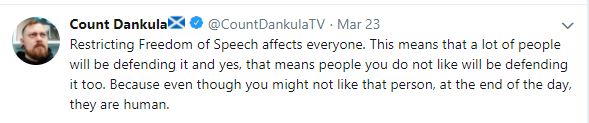
However, it is useful to try and discover what the basis of the humour is and to do that we need to look a little at Meechan himself, otherwise we’re just taking a statement (or joke) out of context. He also calls himself an advocate of free speech, “Pro Free Speech” (@countdankulatv on Twitter), but most of his interactions (that I’ve observed on Twitter) are either retweeting Right-wing ‘dog whistle’ memes:


Making Right-wing talking points:


Or attacking “far Left screechers” and closing down the argument by blocking them or ‘insulting’ them by saying, “you’re a virgin” or “you’re gay,” which is something that is so obviously what a fourteen year-old bully would say, that it’s practically a joke on itself, but it’s still doing the same thing, so it doesn’t actually escape the orbit of being juvenile inflammatory derogatory s***e-talk, but all that being said being a juvenile c*** doesn’t mean you should suffer censure (although this isn’t a general rule, there are exceptions, again context will be our guide) or indeed go to prison (I think this is pretty generally true, otherwise we’ll be jailing the actual 14 year-old bullies for calling someone a “bender”).

To be ‘shocking’ is be part of a reaction against what is considered normalcy, and yet Meechan has also been described as a ‘Centrist’ or ‘Centre-Left’ politically, but I see no evidence of that (which doesn’t mean that it isn’t the case), and he defines himself as being for ‘equality’ and ‘gay rights’ from the Left, but likes ‘Freedom’ from the Right. However, I don’t think that ‘Freedom’ is of the Left or the Right, it could be equated to Libertarianism possibly, but avenues of anti-authority and anti-government are found in both political theories of the Left and the Right. However, I don’t really think that this a discussion Meechan needs to make or can particularly ‘win’ at, especially if he is calling himself a ‘comedian’. Your personal political perspectives are just that, personal, and so long as it doesn’t include depriving others of their rights or lives then keep quiet about it unless you’re engaging in a political message (public or private).

Although we could (and will) debate as to what counts as comedy, this being a personal perspectival aesthetic decision, there is a wider reaching issue of comedy being appropriated for another point. Whether or not you find something funny isn’t the end of the debate, the bully (and the bully’s mates) always finds their insults amusing, those being ‘picked on’ very rarely laugh along (truthfully). That someone finds something amusing, doesn’t always give the joke teller a free pass. Again, this depends on context.

Can any behaviour, an actual Nazi rally for example, be waved away with, “it’s only a joke!”? Obviously, the answer to this really is, “no, of course not,” but perhaps we could jokingly answer in the affirmative, simply to aggravate those that are easily aggravated by such and perhaps that’s the joke here. To mock those that are overly serious or too earnest in their beliefs (something that I’d consider to be a particularly British approach). If the joke is just to annoy the easily offended (and take pleasure in that), can the jokers really be surprised when their targets are indeed offended and complain ‘to teacher’? Don’t poke the moany Tiger if you don’t want him to bite.

So, what’s the joke of “m8 yer dug’s a Nazi” exactly? If it’s not a joke; it’s trying to provoke a reaction, which (especially with a subject like Nazis) is pretty easy to do and this goes back to the whole 14 year-old attention seeking style, and there is an element of this in the humour. If the joke teller has to explain the point of their joke then typically their joke has failed to find an audience. That I don’t find it funny doesn’t mean that I deny that others can find humour in it.

The context of the joke is important. I do want to defend the comedian’s right to make a joke about the sort of thing that might be otherwise upsetting, that is, to be able to make jokes about the holocaust, about 9/11, about those sorts of things. This is part of the role of the comedian as subversive, to push boundaries, to make people think about things in perhaps ways that they had not previously. In being offensive or shocking the comedian can pull someone out of their comfortable ‘bubble’ of opinions (their limited sphere of engagement) and force those people to consider a point of view or perspective that they had refused to entertain before. That context works for the comedian, in that they are a comedian and are indentified as such, but is Dankula to be afforded that protection, is he a comedian?

The question could therefore be, “what makes someone a comedian?” Is Meechan a comedian, because he says he is, or because he made a joke? This leads us into the old debate, ‘when is an artist an artist?’ Is it, when they sell something, that is, they make a living as an artist, it is their occupation. Or perhaps, it is when another confers the title of ‘artist’ or ‘comedian’ upon you and not just anyone, but a recognised authority in the area. Or is it more a matter of self-determination, I call myself an artist because in my mind I have done the work, the thinking, and have made the commitment in my life to be so. Certainly if you went to his channel, if you looked if up because you knew the sort of stuff he makes, but if you just happened upon him on YouTube and this was how he came into prominence when his video was viewed millions of times and shared by people, who then took it out of context.

We might say that the difference is between being a willing participant and finding yourself involved without being asked. Think of the famous ethical thought experiment of someone shouting “fire!” in a crowded theatre. If you were going to a performance were you had prior knowledge that someone was going to cause some sort of an actual disruption, or that they were likely to, then this is a totally different experience to that of the unexpected cry of “fire!” especially as it wouldn’t be considered to necessarily be a false cry. Compare this with, going to see a comedian that is known for making ‘close to the bone’ commentary, you are willingly entering that space, you might expect to be harangued (if in the front row) or hear certain ‘shocking’ language being used, and so on. Similarly, with our interactions online, if you follow a person online, go into a certain online forum expecting a certain level of debate and language, in all these cases you are willingly entering a particular space, but coming across it online accidentally or being sent it unsolicited isn’t a willing engagement. Without asking, without context, the video of Meechan's could be seen as offensive. You don’t have the right, as a comedian, to enforce your comedy on people.

There is no right to not be offended, but there is also no right for you (as a comedian) to expect everybody to engage with you as an audience member without asking them whether they want to be part of the audience first. However, to Meechan's credit, he does give a précis that he’s getting the dog (his girlfriend’s) to do the most horrific thing possible, which is apparently the Nazi salute, that’s the joke. The command phrase for the dog to do this is “gas the Jews.”

Historical context is also important here as well then. Teaching a dog a Nazi salute is one thing, the use of the phrase “gas the Jews” is another. There is an understandable and enormous sensitivity amongst many in the Jewish community to ‘jokes’ such as this. In these cases it is not just what is being said, but who is saying it and in what context.

Then we come back to, what if it’s a cover for something else, all that these edgy jokes seem to manage is to push the Overton window further to the Right. Compare this to the recent controversy of PewDiePie’s ‘joke’ when he got two men to hold up a sign for $5 saying “Death to all Jews,” which was apparently intended as some sort of commentary about how easy it is to get people to do things for money. Well, thanks YouTube millionaire for telling us about capitalism and how broken society is! However, it’s also a method of making those who are the subject of the ‘joke’ look like the bad guys for complaining and ‘spoiling their fun’. Indeed, that’s how Stormfront (a well-known neo-Nazi website, only recently shut down in 2017) saw the usefulness of PewDiePie (in 2015). Although they probably learned that active support from them would then ‘scare off’ a great number of other potential recruits. Could Meechan therefore be a willing or unwitting participant in this?

There is also the ‘problem’ of Meechan’s company. Various ‘rationalists’ and others, who lightly or firmly, place themselves within the Alt-Right, not least, Tommy Robinson the former EDL leader who helped ‘support’ Meechan during the trial. The defence that, “you can associate with people of different political persuasions, and you can learn from that relationship.” This strikes me as incredibly glib and a distraction technique that puts the impetus on the accuser to define their parameters rather than the accused to make any reasonable defence of their own actions.


Markus Meechan and Stephen Yaxley-Lennon AKA Count Dankula and Tommy Robinson (above)
Paul Joseph Watson, Carl Benjamin, and Meechan (top)


Frankie Boyle once made a joke/analogy/comment inspired by the story of a Gail Porter nude being projected unto the Houses of Parliament that people then gave her grief about that. Boyle’s suggestion was what if someone was to project hardcore pornography onto the side of a school, would they then arrest Ron Jeremy? (i.e. the Porn Actor in the film rather than the people who actually projected the image.) Although I can’t now find a clip of him saying this, hopefully it does exist.

So, similarly, the (assumed) ‘viewer’ who did not choose to view Dankula’s comedy video, in which it was sent to them by a friend, that wasn’t Dankula that did that, not personally and not by direct action on his part. It was someone else who decided to do that, so he could not be held as culpable for that. Dankula did make the video and he didn’t control how it was distributed, is that more to do with the companies involved (i.e. YouTube) and with how we share information on the internet now? And perhaps his culpability was simply that he chose to allow to make it shareable, the possibility that others might share it was already known to him, and although he gave a précis it didn’t stop it being shared, he is therefore the creator of the content and despite not being the sharer it did end up being viewed by someone who found the video offensive. However, he couldn’t stop it being shared either, not if he wanted it to be seen by many people, was his error then narcissism? He could have made it private and only available to his friends and he did not. YouTube could have blocked the video, but they did not. Should the offended parties have therefore taken their complaints up with YouTube (the ‘projectionists’) rather than Dankula the content creator (the ‘porn star’)? What YouTube did do, was to ‘demonitize’ [sic] Meechan’s videos:


They’ve refused to make a moral decision, but have made instead a financial one masquerading as a moral one and as such they have failed to take any real action or stance here. Indeed, why would they without any external intervention? Internet service providers as well as internet media companies have a history of not controlling their spaces, not for fear of the loss of freedom of speech, but for the loss of revenue.

Freedom of speech doesn’t give one the right to make statements that seek to destroy (actively or indirectly) the right to free speech of others (by making them afraid to speak out for themselves or their group, if such is being targeted). Take, for example, this definition from the British legal case Norwood v. United Kingdom in 2003.
The Court said the purpose of the European Convention on Human Rights is to ensure that no-one can rely on human rights to destroy the rights or freedoms of others.
Let’s end this, by giving Meechan a chance to set out his beliefs about freedom of speech and what that means.


The problem here is that, yes Nazis are indeed people too, but freedom of speech doesn’t mean allowing those that want to “destroy the rights or freedoms of others” a voice. Murderers are still human beings, which affords them some rights (if I hadn’t gone on so long already, I’d start a discussion about the Death Penalty, but let’s save that for another day) but not their continuing freedom. For example, denying the holocaust isn’t just an ‘opinion’ like whether Dankula is funny or not, it’s an attempt to deny facts (see Irving v. Penguin Books and Deborah Lipstadt, 2000). However, and this is really important, not everyone you disagree with is a Nazi, some just have different ideas or a different perspective. Being able to disagree without someone, almost fundamentally, and still have a reasoned debate about something is what cases like this make more difficult. It is a skill that, I worry; we are losing in our emotive internet age. Although I do not blame the internet directly, it is merely a tool, but it is our lack of collective and individual responsibility that is leading to this. We look to an authority to make our decisions for us and then fret that these companies who are in charge are not moral agents but only financial ones, if our masters are merely concerned with making money, who is making our moral choices for us if not ourselves? It seems we are losing the ability to even articulate what we think freedom actually is and what it really means to us. Is it simply being able to say whatever ever we want when we want without consequence? If that’s all freedom of speech means to you, then you are missing the point.

Freedom of speech should mean being able to disagree with authority and persons in power and not fear retribution, to discuss alternative ideas and be held up to fair scrutiny not merely mob justice, to be able to be wrong and then to be educated of your fault, to highlight errors and potential problems as you find it in society and be dealt with in an even-handed manner. Indeed, in all of these things we might say that what we want in advocating for freedom of speech is a fair, rational, humane and open society where consequence and context are regularly and thoroughly analysed.

Meechan is not completely innocent, nor can blame be removed from him entirely. He is after all, as the judge said an intelligent and articulate person. At the age of 29, we cannot expect that he had not foreseen the potential offense of his ‘Nazi Pug’. I think that Meechan made a mistake, the mistake was not simply making a joke ‘in bad taste’, because being shocking, vile, and insulting absolutely on purpose is the point of being an internet troll and it is this that I think constitutes the basis of the original joke, not the ‘prank’ on the girlfriend, but by gleefully abusing ‘triggering’ phraseology and behaviour. No, the mistake Meechan made came after the attention spike that greeted the video online.

There were two options available to him, there are always many more of course, but boiled down to two distinct paths of actions they are:
  • Apologise; learn the historical and social context of what you have done that is wrong, accept personal responsibility and culpability, take down the video and/or suffer abject humiliation, be crushed by ‘the Man’ and by a society that wishes you would just shut up and do what they tell you, or
  • Stand up for yourself; fight for the fundamental right of free speech itself, gather around you fans, admirers, supporters, like-minded folks and ‘activist’ leaders, all of whom offer you praise and congratulate you for the stand you are making, they tell you that you’ve done nothing wrong and that it’s in fact the totalitarian liberal elite and their army of whiny deranged autistic far left screechers who are the ones that are really in the wrong, you’re totally right...

Apologies, but you might have noticed that I wasn’t been utterly truthful with my portrayal of Meechan’s choices there. Indeed, I was making a possibly accurate parody of how, I think, he ended up seeing the situation. It might have started as ‘only a joke’ but it’s ended up being a political action, albeit one that is based in a failure to take personal responsibility.


In conclusion, Meechan was no angel to begin with, but I still believe that the original video that while crass was by itself no crime. However, ‘post event’ he seemed to become, for want of a better expression ‘radicalised’ and became a mouthpiece (willing or unwitting) for far-Right efforts to normalise hate and to further push the Overton window. Comedy was never really on trial here, because we were aren’t dealing with comedy as we currently know it, perhaps ‘trolling’ will become the comedic style de jour in years to come and then all this will look very silly (and oppressive) in hindsight, but I sincerely hope not. The comedy of bullies, while still technically comedy, should not represent a society that holds a rational compassionate outlook, but maybe I’ve just missed the joke.

Thursday, 9 March 2017

Who Reviews the Reviewers? #1 Redacted Tonight

I was originally thinking of starting a new blog that looked at reviewing reviewers, because there had been such an influx of YouTube vloggers who are film critics and as they were (and still are) of such a contrast in styles and quality I thought I'd give an objective view on how each of the reviewers approaches their own review. Meta-reviewing if you like.

However, I never really got around to that, because I doubted whether all the effort would be worthwhile. So, although I might well write about internet film critics one day, this piece is about a different type of reviewer.


I was introduced to this programme by a friend who likes his independent media. However, unlike various YouTube based media reporting (such as The Young Turks), Redacted Tonight - 'satirical news' hosted by Lee Camp - is funded/owned by Russia Today (RT) the 'news' network backed by the Russian Government.

All the broadcasts are freely available online, via the RT site or on YouTube, which helps give a veneer of independence. Even if the cleverly worded title also makes no attempt to hide their backers.

I'm not saying that Redacted Tonight are making 'fake news' themselves, unlike RT who have faced repeated accusations of propagandist fabrication and airing any criticism of the 'West' whether conspiratorial or manufactured, indeed, Redacted Tonight seems like a softening of approach by RT even if they keep to the script of constantly criticising the 'West' without offering the same critical eye upon Russia (obviously).

Redacted Tonight has the appearance of a John-Stewart-esque comedy news show, and is hosted by the diligently sincere activist/comedian Lee Camp. It is strident in its criticism of the main stream media "liars", the US government, politics in general "corrupt", big business, and so on.

I don't deny Lee Camp's genuineness, as he has been a writer, satirist, and vlogger for many years before Redacted Tonight aired. I don't doubt that he has always been a critic of the US government, the over-involvement of corporations in civic life and so on. However, it's a bit galling that he's now doing so on behalf of a government that is more authoritarian, dictatorial, and exploitative than his own. Still, it's a sacrifice to get one's voice heard I suppose you could argue.

Indeed, one could suggest that the British government's involvement with the BBC is similar and there isn't any great example of Russian government interference with Lee Camp's script or the programme as a whole. The problem here is not having enough information to offer a clear criticism, because if there's no example of specific interference then we can't claim that any has taken place.

Why would the Russian government need to interfere anyway? Because unless Lee Camp makes the brave/suicidal move of offering focused criticism on Russian foreign policy, for example, there's nothing they need to stop. The criticism of the constant failings of US and European governments, their corruption and the collusion with big business is being constantly highlighted.

However, why wouldn't this knowledge worry the Russian government? Because with this knowledge an aware citizen would see the failings in their own country, or would become determined to become an activist for progressive change and stand-up against authoritarian leadership... except, that's not what is happening anywhere and this is why Russia is fine with this.

For one, it's only criticising the 'enemy' and although the same criticism could easily be leveled at Putin and his government, it isn't, and for a passive viewer you are left with the feeling that they (Russia) are doing nothing wrong. A feeling that would be increased if one read the biased RT news. The criticism itself is very 'light'. In a 25-30 minute programme, Redacted Tonight covers only a few stories and in a very shallow manner. There isn't a great deal of information, no other sources are cited, and the viewer isn't directed to other avenues where they could learn more themselves (a reading list if you like). This is the problem with the John-Stewart era of entertainment news, especially for the Left, because although there are many John-Stewart-esque shows and comedians now (Colbert, Oliver, Noah, Bee) they're having a relatively soft impact upon people's general opinion. Why? Because people treat this as entertainment primarily, they don't see it as 'real' and therefore aren't compelled into activity.

I'd continue with this line and suggest that the only strong criticism given out in this manner, the Nightly Show show with Larry Wilmore, was cancelled. You could highlight many possible reasons for the programme being cancelled, but I would suggest the most influential reason was the perceived 'didactic' tone of Wilmore, basically, he highlighted specific cultural problems in America and didn't pull any punches. The 'negativity' of this approach was simply too much for an audience that was expecting some light laughs at the Republicans, but when it's pointed out that 'soft liberals' are just as much too blame for the inherent racism and other problems in the country... it's turn off time. I think that's what the Comedy Central CEO meant by "not resonating."

To conclude, Lee Camp might be truthful with his criticism and correct with his choice of targets, but he needs to decide whether he's a comedian or an activist and writer. Political information delivered as entertainment fails to show itself up for proper discussion or rational critique. It's just given as a 'point of view' and this is the death of rational debate. Example: Saying that the Holocaust didn't happen, isn't just an 'opinion' and shouldn't be allowed to be presented as such. Now, I'm not saying that the people at Redacted Tonight are saying anything so revolting, but saying something and getting whoops and cheers and laughs doesn't make it correct (even if I basically agree with the criticism). It's a very basic short-hand, it's another example of an echo-chamber, it isn't showing why it is correct (assuming that it is). Jokes aren't an argument. These programmes mollify an audience, they don't inspire activism, they stop it. This is why Russia and other governments like the John-Stewart-esque approach.

His style of yelled dismay (much like Cenk Ungar, but with jokes) is also a tad wearing and needs toning down. Just because you're shouting doesn't make it true (cf. an academic told me once that the principal failing of first year argumentation is confusing italics for making an actual point in the argument). Much like a parent of a toddler prone to tantrums must feel, eventually you stop listening...

Also, stop scowling in your publicity photos. You're not a hard-hitting journalist. You're a comedian.